
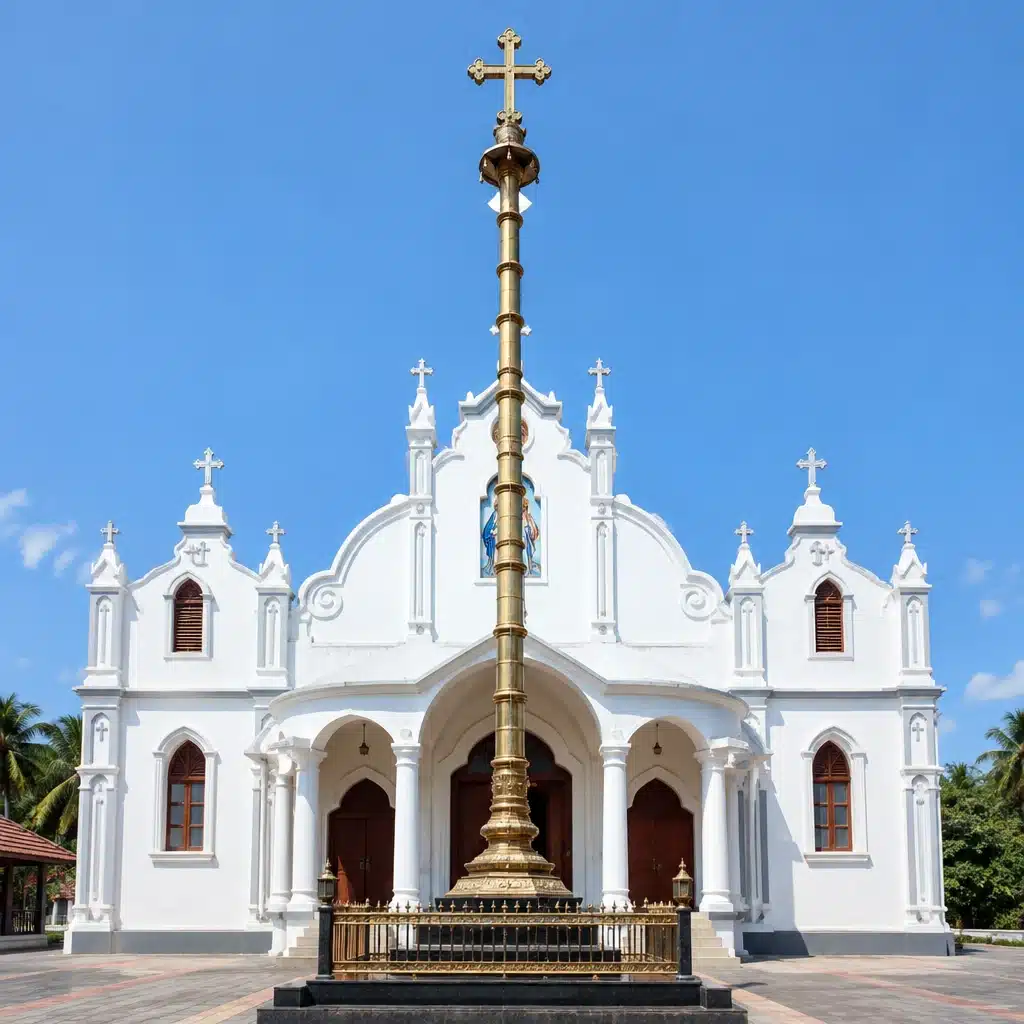
A church kodimaram is one of the most distinctive sights in Kerala. In front of many churches across the state stands a tall, metal-clad flagstaff, usually crowned with a cross, where the feast flag is raised at the start of every perunnal. It is a shared Kerala tradition that links church architecture with the wider craft heritage of the land. This guide explains the meaning of the church kodimaram, its traditional designs and materials, and how a parish can plan, craft and install one with care.
Kerala Metal Art has crafted kodimarams and sacred metalwork for churches and temples since 2004. The guidance here comes from our work with parish committees, priests and craftsmen on church projects.
In this guide
The Church Kodimaram: A Kerala Tradition
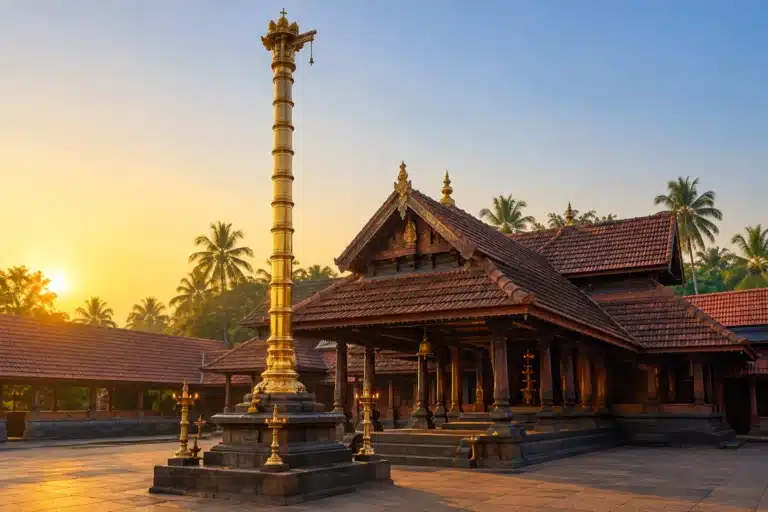
The flagstaff, known in Sanskrit as the dhvajastambha, is best known in South Indian temples. Kerala is special because churches here also adopted the flagstaff as part of their own identity. Today, a church kodimaram stands before many parish churches, shrines and pilgrim centres, often in front of the main entrance and close to the open-air cross.
Each parish gives its flagstaff a slightly different character. Some prefer a plain, stately column with a simple cross, while others choose rich bands of decoration and an ornate crown that matches a historic façade. Both are equally authentic; what matters is that the design suits the church and the community it serves.
For the parish, the kodimaram is a sign of the church’s festive life. It marks the church as a place of celebration, it gathers the community for the flag hoisting, and it becomes a familiar landmark for every family in the parish. Generations of parishioners remember the moment the feast flag climbed the kodimaram as the true beginning of the perunnal.
A shared craft heritage
Kerala’s Christian communities have lived alongside their neighbours for many centuries, and church architecture in the state reflects that shared life. Brass lamps, processional umbrellas, carved wooden ceilings and the flagstaff all appear in Kerala churches in forms that feel at home in the local landscape. The church kodimaram is one of the clearest examples of this blending of faith and regional craft.
The same families of craftsmen who shaped brass for temples often worked for churches as well, so techniques, motifs and finishes travelled between communities. When we craft a church kodimaram today, we draw on this common heritage while respecting the Christian symbols and customs of each parish.
The kodimaram and the open-air cross
Many Kerala churches also have an open-air cross in the courtyard, often in stone, where devotees light candles and pray. The church kodimaram usually stands near this cross or along the main approach to the church. Planning the two together, in terms of height, spacing and style, gives the church forecourt a balanced and dignified appearance, and keeps space free for processions and gatherings.
The Church Kodimaram and the Perunnal
In Kerala, the annual feast of a church’s patron saint, the perunnal, traditionally begins with a flag hoisting, often called kodiyettu. After prayers, the feast flag, usually bearing the image or symbol of the patron saint, is raised on the church kodimaram. Novenas, processions, special Masses and celebrations follow over the coming days.
Some of the best-known feasts in the state, such as the celebrations at Edathua and many other parishes, open with this ceremonial hoisting. In several places, processions also circle the kodimaram, which makes its surroundings as important as the flagstaff itself.
Because the flag hoisting is such a public moment, the church kodimaram must look dignified and work reliably. The rope and pulley must run smoothly, the cross at the top must be secure, and the finish must shine in the festival lights.
Traditional Church Kodimaram Designs
Church kodimarams share the slender, single-pole form of the Kerala flagstaff, but the details follow Christian symbolism and the character of each parish.
The cross at the top
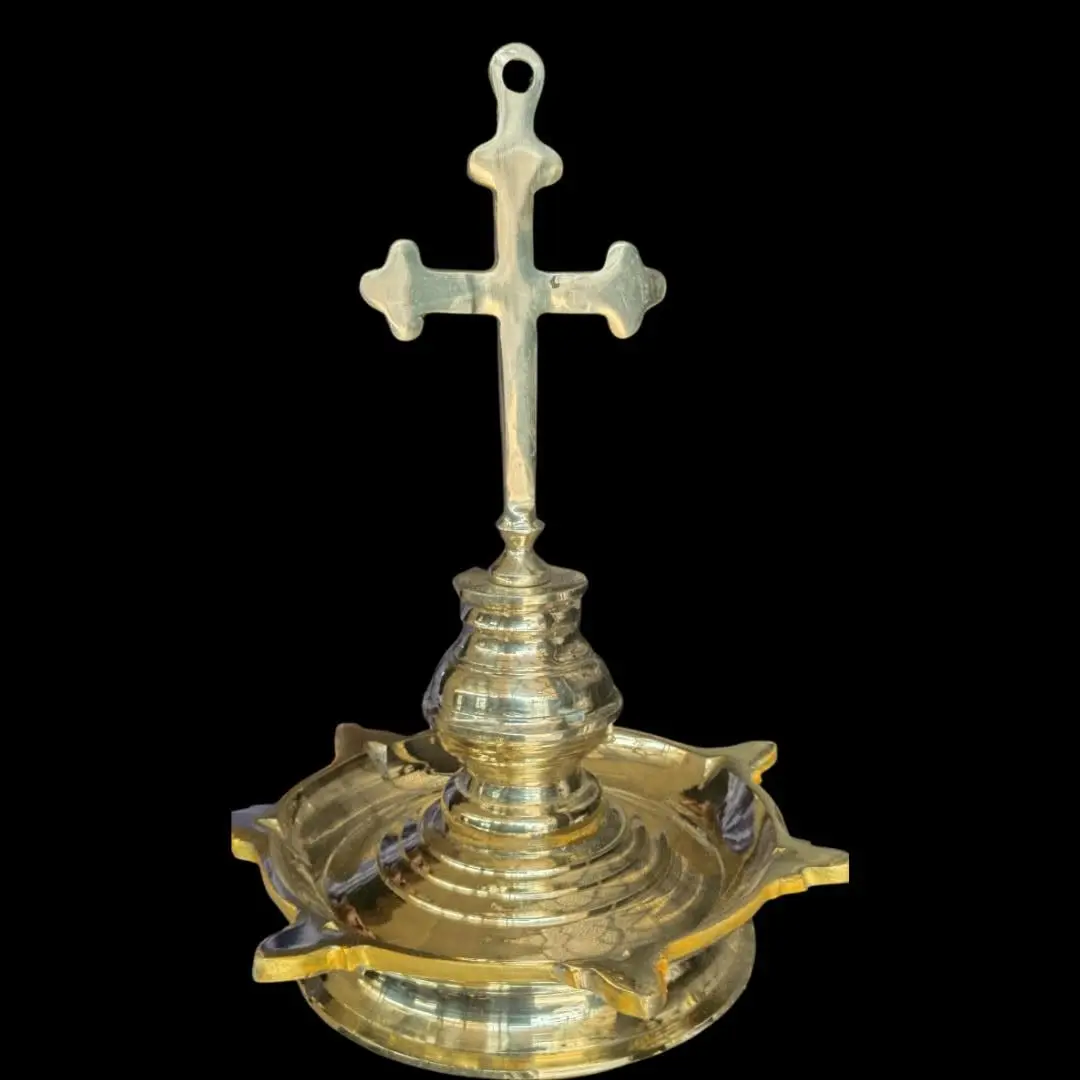
The crowning element of a church kodimaram is usually a cross. Its style can be simple and bold, or richly ornamented to match the church’s architecture. Some parishes prefer a design that echoes the traditional Kerala sleeba cross, while others choose forms that match the altar or façade of the church.
Decorated sections and bands
The metal sections that cover the pole are decorated with bands, beads and floral patterns. Many designs use lotus or leaf motifs that belong to Kerala’s shared craft heritage, while others introduce Christian symbols such as the cross, the dove or the chalice in panels at selected levels.
The base and surroundings
The base is usually a stepped pedestal, often in granite, with a metal cover around the foot of the pole. Because processions pass close to it, the base and the paving around it are planned together with the parish to ensure safe movement and a clean appearance.

Church Kodimaram Materials and Finishes
The choice of metal shapes the appearance and the long-term care of a church kodimaram. Most parishes choose from the following options.
- Brass: a bright golden finish with excellent hand-decorated detail and a balanced budget. It is the most common choice for a church kodimaram and is easy to restore by polishing.
- Copper: a traditional, long-lasting metal that ages to a deep, antique tone, or acts as the base for gold covering.
- Gold covering: copper sections covered with gold for the most prestigious, radiant finish, often chosen for major churches and pilgrim centres.
- Bronze castings: used for the cross, finials and ornaments where strength and crisp cast detail are needed.

Our comparison of brass and bronze kodimaram metals explains these choices in more depth.
How a Church Kodimaram Is Crafted
Every church kodimaram we make is designed for one parish. The process follows the same careful steps as our temple work, with the parish priest and committee guiding the design.
1. Discussion and site visit
We meet the parish team, understand the church’s history and feast traditions, and visit the site to study the position, the height of the church façade and the procession routes.
2. Design and approval
Our designers prepare drawings of the full church kodimaram, the cross and the decorative sections. The parish reviews them, and changes are made before any metal is shaped.
3. Crafting the sections
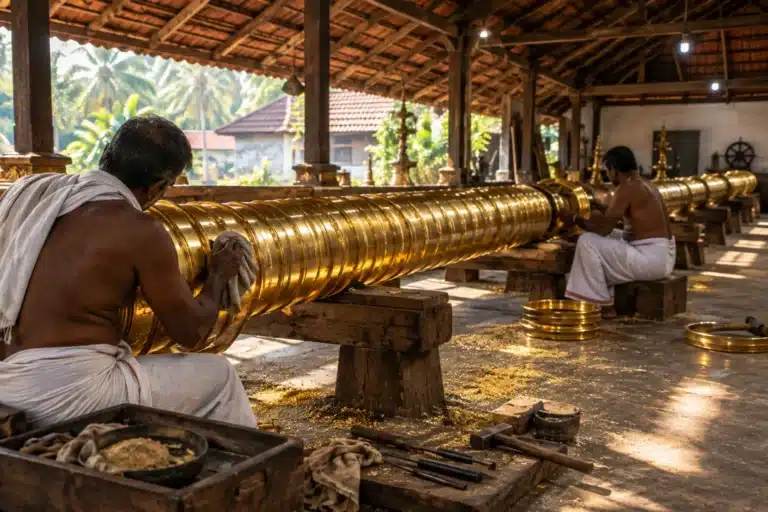
Brass or copper sheets are cut and shaped into sections, and the decoration is raised by hand using the repoussé technique. This is the slow, skilled work that gives a handcrafted kodimaram its depth.
4. Casting the cross and ornaments
The cross and finials are modelled and cast, then finished by hand so that every edge and ornament is crisp.
5. Finishing
Each section is polished, plated or gold covered as agreed, then inspected and numbered for installation.
Installation and Blessing
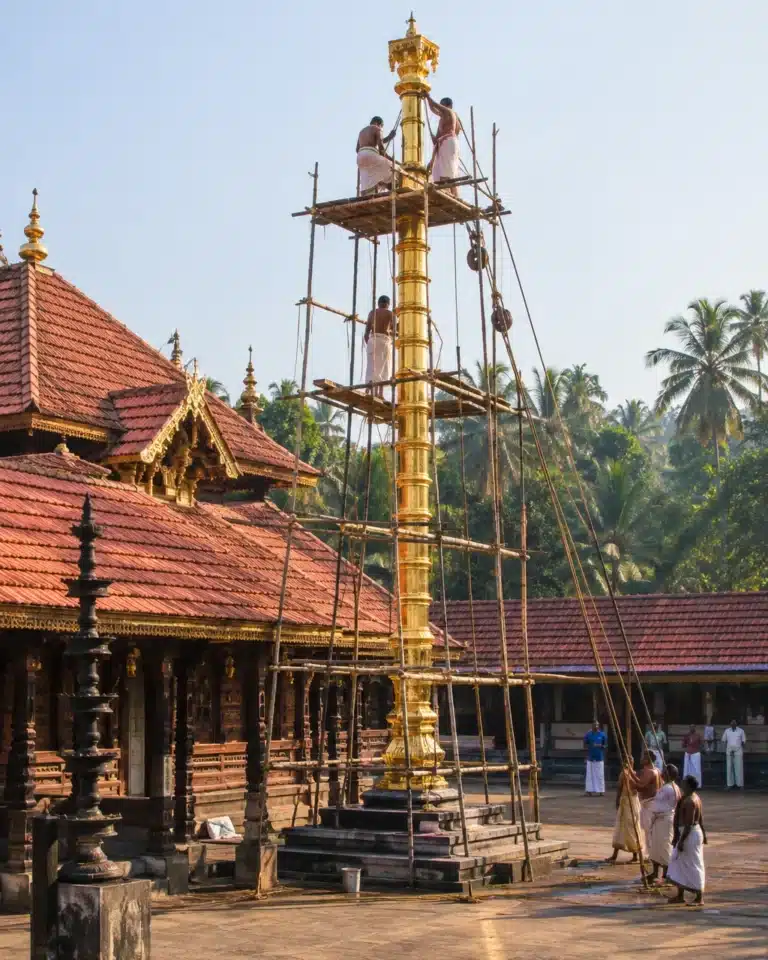
Installing a church kodimaram follows the same technical principles as a temple flagstaff. The foundation and base are prepared, the core is raised and aligned perfectly vertical, and the metal sections are fitted from the bottom upwards. The cross, ornaments and flag fittings are fixed last and tested with a trial hoist.
The parish decides when the new flagstaff will be blessed, and we plan the work so that the church kodimaram is complete, cleaned and ready well before that date, usually ahead of the perunnal. Our kodimaram installation guide describes each technical step, from site survey to handover.
Planning Guide for Parish Committees
A well-planned project is calm and joyful. These steps help a parish move from the first idea to the blessing without last-minute pressure.
- Agree the vision: discuss the style, height, metal and cross design with the parish priest and committee.
- Fix the target date: decide when the church kodimaram should be ready, usually before a perunnal, and plan backwards from it.
- Choose an experienced maker: look for completed church and temple work, an in-house workshop and installation by the maker’s own team. Our guide on choosing a kodimaram manufacturer lists the key checks.
- Approve drawings: review the drawings carefully and confirm every detail in writing.
- Prepare the site: arrange access, storage, utilities and any approvals, and involve a civil engineer for the foundation where needed.
- Plan the surroundings: consider paving, lighting and procession space around the base.
- Arrange after-care: agree how the flagstaff will be cleaned, polished and inspected in the coming years.
Choosing the right height and proportion
The height of a church kodimaram should be decided in relation to the church itself. A flagstaff that is too short looks lost in front of a tall façade, while one that is too tall can overpower a smaller church. We study the façade, the width of the forecourt, the distance from the main door and the view from the road before suggesting proportions.
Practical points matter too. The flag must be visible from the approach road, the hoisting rope must be easy to handle, and overhead lines or trees nearby must be considered. For very tall structures, the foundation and wind load need professional engineering advice. We prepare drawings that show the church kodimaram in front of your actual church, so the parish can see the proportions clearly before approving them.
Involving the parish community
A new church kodimaram is often a gift of the whole parish. Many communities invite families to contribute, and some record the names of donors or the date of blessing on a small plaque near the base. Sharing the drawings, progress photographs and a visit to the workshop with parishioners builds excitement and helps everyone feel part of the project.
Parish youth groups and family units can also take part in preparing for the blessing and the first flag hoisting on the new flagstaff. These shared moments turn a construction project into a memory the parish will treasure for decades.
Restoring an existing church kodimaram
Not every parish needs a new flagstaff. Sometimes the existing church kodimaram is structurally sound but the metal has darkened, a few sections are dented or the cross needs repair. In these cases, careful cleaning, repair of damaged parts, replacement of worn bands and professional polishing can bring it back to life.
If the timber core has decayed or the flagstaff leans, replacement is usually the safer choice. We inspect the existing structure first and explain clearly whether restoration or replacement is the responsible path, so the parish can decide with full information.
Lighting the church kodimaram
Many parishes light the flagstaff during the feast. Plan the lighting with the maker so that fixtures do not damage the metal and wiring runs safely. Soft, warm lighting shows off the golden finish of a church kodimaram beautifully at night without glare.
Care and Maintenance
A church kodimaram faces sun, monsoon rain and festival crowds every year. Simple, regular care keeps it safe and beautiful.
- Clean the lower sections gently and regularly to remove dust and stains.
- Avoid harsh acids and abrasive powders, especially on gold-covered surfaces.
- Arrange professional polishing before major feasts to restore the shine of brass and copper.
- Inspect the cross, upper fittings, rope and pulley before every perunnal.
- Discuss earthing and lightning protection for the tall metal structure with a qualified engineer.
A feast-season checklist
A few weeks before every perunnal, a short inspection helps the flag hoisting go smoothly in front of the whole parish.
- Run the rope through the pulley and replace it if it shows wear or fraying.
- Check that the cross and upper ornaments are firm and undamaged after the monsoon.
- Clean bird droppings, dust and soot from the base and lower sections.
- Arrange polishing early enough that the work is finished before decorations go up.
- Test any lighting fixtures and make sure cables are secured away from the metal.
- Confirm who will handle the flag on the day and walk them through the hoisting.
Safety during processions and celebrations
During the feast, large crowds gather around the church kodimaram, processions pass close to the base and fireworks may be used nearby. Keep a clear space around the foot of the flagstaff, avoid tying heavy decorations or banners to the upper sections, and never allow anyone to climb the structure. Decorations should be light, secured to the base or to separate supports, and removed after the feast so that they do not trap moisture against the metal.
These simple precautions protect the parishioners, the finish of the flagstaff and the timber core inside it, so the kodimaram stays safe and beautiful for every perunnal to come.
Temple and church traditions side by side
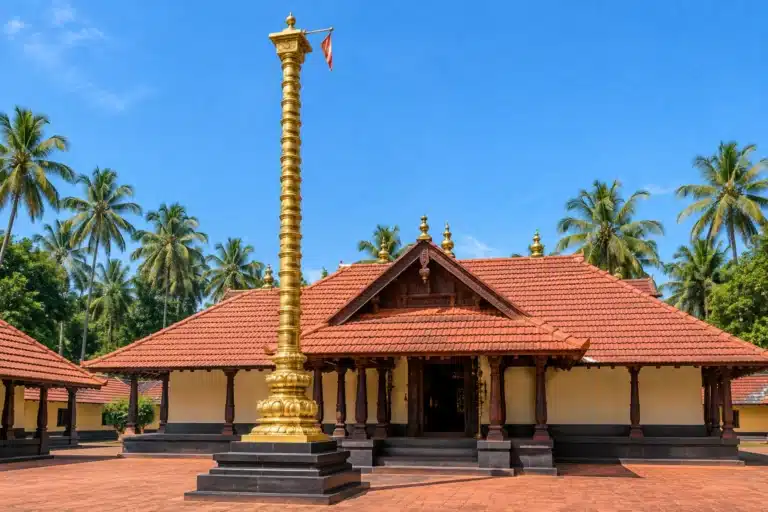
The church kodimaram and the temple kodimaram share the same craft roots, the same materials and many of the same techniques, but each follows its own community’s symbols and ceremonies. Read our temple kodimaram guide to see how the flagstaff tradition developed in Kerala temples.
Why parishes choose Kerala Metal Art
- Church and temple kodimaram craftsmanship since 2004.
- Brass, copper and gold-covered church kodimarams, made to order.
- Hand-decorated sections and finely finished crosses and ornaments.
- Designs developed with the parish priest and committee.
- Installation, cleaning and after-care by our own team.
View the kodimaram for church product page, our handcrafted sleeba cross, completed projects in the photo gallery, and our full list of services.
Planning a kodimaram for your church?
Share your parish details, your preferred design and your feast date. Our team will guide you through the design, crafting and installation.
 Kodimaram
 Kodimaram
 Kodimaram
 Kodimaram